Wednesday, June 20, 2018

Keep It Simple

Nakanacagi Village - Vanua Levu, Fiji

Kava ceremony with the Nakanacagi Village.
Marika Votomosi (third from the left) is the leader of the Nakanacagi village.  He is also the person who taught me how to tie a sulu.  

I was struggling to get my sulu "right" prior to attending a kava ceremony.  I must have looked pretty pathetic.  

Soon, a stranger approached, grabbed the ends of the fabric, and immediately tied a knot.  With a smile he added, "keep it simple".


That stranger turned out to be the leader of the village as well as region.  I spent the evening at his side sipping kava and sharing stories and time.

From then on, I noticed that most of the other sulus I saw  while in Fiji were folded over and held tight similar to how you might wrap a towel around your waist.  That is not the Marika Votomosi way.  

"keep it simple"


Friday, May 4, 2018

Wearing my first Sulu. Fijian Culture, Religion, and Nature.

Celebrate Fiji. 

That is my plan for the 10-day trip ahead. 

To quote the Lonely Planet travel guide to Fiji,

"Fijians are a famously hospitable people with personalities as sunny as the islands they live on".    Wow.

This is one of the most important work trips of my career.  An opportunity to be involved in the permanent protection of habitat for one of the world's most endangered species.  I am deeply appreciative of  partners like RainForest Trust and a host of Fijian organizations like NatureFiji-MareqetiViti and the National Trust of Fiji.  (RainForest Trust did a great write up of the effort Project Description.)

But! this isn't a Work blog.  The purpose of this blog remains the same; to reflect, to pay attention, and to record the people and places of this world. 

Similar to my post on Belize (Belize Trip) I hope to publish at least three blog post corresponding to my time on the islands of Viti Levu, Vanua Levu, and Taveuni.  I will also be active on a new instagram account

So now; the wait, the wonder, and the realization that no matter how many travel books you read...you really dont know what is going to happen to you until you get there. 

Au saa liu mada,

-kp


Thursday, June 15, 2017

A "Day" at the Museum

Nancy B. Simmons, Curator in Charge
The Department of Mammalogy at the American Museum of Natural History houses over 275,000 specimens, making it the third largest collection of recent mammals in the world.  The exhibits are phenomenal and the research is critical. 

The museum is also the very famous backdrop for the Night at the Museum film series.  I love those movies but the real behind the scenes action of the museum is so much cooler.  Every nook, cranny, corner, and eave is stuffed.  What a place.

Shameless selfie in the Hippo Room


Thanks so much to Dr. Nancy Simmons for the amazing tour.  

And if you are in town June to August don't miss the Evening Bat Walks in Central Park hosted by the NYCity Batgroup.  You can sign up online and then meet up at the Museum entrance on 77th Street between Central Park West and Columbus Avenue. 
View of Manhattan from Central Park during a "Bat Walk".


After a little informal presentation on "the night life" of the park, you are off with a bunch of new friends and a host of gadgets that allow you to hear and see the ultrasonic sounds of echolocating bats. 


Tuesday, July 22, 2014

Connecticut Avenue, Washington D.C.


I get to Washington D.C. about four times a year.

When I visit, I tend to hang around Connecticut Avenue.  A stretch of bars, restaurants, shops, and hotels a little northwest of the White House.  

It is a pretty easy ride on the Metro, but you do need to switch trains.

You take the Blue Line (Largo Town Center) from Reagan National Airport to Metro Center and then the Red Line (Shady Grove) to Dupont Circle.  Once surfaced, you are there.

At the top of the station, chiseled into the granite, is a portion of Walt Whiman's poem, The Wound Dresser:

    Thus in silence in dreams’ projections,
    Returning, resuming, I thread my way through the hospitals;
    The hurt and wounded I pacify with soothing hand,
    I sit by the restless all the dark night – some are so young;
    Some suffer so much – I recall the experience sweet and sad…

Whitman volunteered in Washington's hospitals during the civil war and according to this post, city leaders were looking to honor those who nursed the sick during the early days of the HIV crisis.


Once in the vicinity, my rituals include strolling through Embassy Row west of Dupont Circle, reflecting at the statue of the Goddess Saraswati, and Bistrot Du Coin.


I was introduced to this French Gem by my friend Brian.  It is now a non-negotiable destination for me.

My routine is always the same.  I squeeze past the people waiting on a table and find a spot at the bar. I order Le Steak Maison and relax.

When I can, as sometimes I am priced out, I stay at The Fairfax.

In addition to just being a fantastic hotel, it has one of the most resplendent back-room bars I have found.

The warm light from the fireplace creates the perfect atmosphere for weary travelers to talk and plan.


Saturday, July 12, 2014

Minneapolis

The Mississippi River.


I Love Minneapolis.  


I land at the airport, stroll past the cabs and rental cars, and head directly for the light rail.


Once on board, the blue line takes me to one of the most scenic downtowns in America.


Downtown is where you find the McKnight Foundation a supporter of a former employer, and many other conservation organizations.  So, I have had plenty of opportunities to visit them and the city.

My favorite place?  Mill Ruins Park on the west bank of the Mississippi River by St. Anthony Falls.  


Mill Ruins Park.
From the park literature, "In its 19th-century heyday, this area of mills, canals, tailraces and other historic resources comprised the largest direct-drive water-powered facility in the world."   The ruins look much older than they are and remind you of a castle more than a mill. 


The juxtaposition of the old ruins and the modern buildings in this area is really cool.  Not to mention the miles of connected trails on both sides of the scenic Mississippi River.

On the way back to the airport I always stop at the 50th Street/Minnehaha Park Station. 


Minnehaha Falls.
Minnehaha Park is almost 200 acres, full of trails, events, and a surprisingly good food vendor ( Sea Salt ). 

I grab a drink, a fish taco, and head to the main event in the park, a 50 foot waterfall that seems to appear out of nowhere.  The huge chasm and waterfall remind me of the impossible landscapes my son (3) and daughter (5) create with Minecraft.  I soak up what I can of the peace of this place and then start the 668 mile journey back to them.

#minnehaha_park , #minneapolis , #mill_ruins_park

Wednesday, August 7, 2013

Charleston SC: Big Cypress and Blue Haint Porches

With Norm back in the Fall of 2012.
Quick trip to work at one of my absolute favorite places on the planet, The Audubon Center & Sanctuary at Francis Beidler Forest.  Here is where you find the second-oldest confirmed Bald Cypress tree in the world. But also my friend, mentor, and spirit guide Norm Brunswig.  Norm is now the state director of Audubon's programs in South Carolina, but over 30 years ago he was the first manager of this sanctuary.  His innovative conservation techniques and local and regional partnerships expanded the sanctuary, which contains one of the last virgin stands of cypress-tupelo swamp forest in the country, from 3,400 acres in 1969 to its present size of more than 12,000 acres. This tract is considered an important bird area by Audubon, "globally significant" by the American Bird Conservancy, and is a U.S. National Natural Landmark.

Sunday, July 28, 2013

Belize 2013: Turf

A must have book for Crooked Tree.
Crooked Tree Wildlife Sanctuary is about a 30 minute drive from Belize City on the Northern Highway.  It was the first wildlife sanctuary declared by the Government of Belize (1984), and because of its significance as a wetland, was declared a RAMSAR site in 1998.  The sanctuary is managed by the Belize Audubon Society through agreement with the government.  Over three hundred species of birds have been recorded at the sanctuary including many Yucatan specialties.

The Sanctuary consists of 16,000 acres of lagoons, creeks, logwood swamps, broadleaf forest and pine savanna.  In the center of the lagoons is Crooked Tree Village a European settlement dating back to the 1740s.

We were there to meet with three groups; the Belize Audubon Society, tour guides and hotel operators, and the village council.


View of the Lodge from the lagoon.
There are several lodging options that surround the sanctuary.  We stayed with Mrs. Verna at the Bird's Eye View Lodge.  Another option that caught my eye was the Crooked Tree Lodge. From both, or that matter any, you can pre-book or sign up for impromptu birding trips.  As we learned from our meetings, birding tour guides are at a premium so I would suggest making arrangements in advance.

Recently sighted; Jaguar?!
Almost any lodge, museum, or nature center will keep a list of birds and animals sighted on the grounds.  Usually on a whiteboard in one of the public areas. This is a great place to see what people are viewing in the area and get an idea of what you can expect.  The board at Bird's Eye had "Jaguar spotted 10:00 a.m."  That made an impression!


Before our meetings we did a quick guided birding trip on one of the lagoons.  It was during the wet season so there was plenty of water everywhere and thus not a lot of congregations of birds or animals. This and the fact that we were not there during peak migration meant the birding was much sparser than usual.  Even under these conditions, I managed 14 life birds out of a total 23 birds sighted.  I plan on returning in November during peak season with one of the Audubon Chapters that hosts tours to the area.

Breakfast before birding.
Front: Filippo, Karen, (me) and Ishmael from the
Multilateral Investment Fund.  Back: our guide Lenny
and Pat the Publisher of Audubon Magazine.


Monday, July 22, 2013

Belize 2013: Surf

July 21, 2013

Hol Chan Marine Reserve
Off the southern tip of Ambergris Caye is Belize's oldest marine sanctuary, the Hol Chan Marine Reserve.  Hol Chan is Mayan for "little channel" as the park centers around a 25 yard wide and 30 foot deep opening through the reef with both sea grass and coral habitats.  The reserve was established in 1987 with the addition of the Shark Ray Alley area in 1999.  It is a diverse area with about 160 species of fish, 40 types of coral, sea turtles, and marine mammals like dolphins and manatee.  We were here during the off season so we felt like we had the area largely to ourselves.

Estel's Dine by the Sea in San Pedro Town Belize
You can count on burning about 250 calories an hour snorkeling.  So before we started we estimated that about two pancakes, two cups of coffee, and a few eggs from Estel's would fortify us for the adventure.

Estel's is a sea side spot that shouldn't be missed. Like most of the places we visited, it was warm, friendly, and eclectic.  The hardest part of the experience was navigating all the choices on the menu and finding the best place to sit and enjoy the people and the view.  Also, like many places we found, despite Belize's reputation for terrible internet access, the WiFi was free (password blackcoffee btw) and adequate to accommodate our updating and texts.  

After breakfast we headed for our 9 a.m. appointment to meet up with Ched Cabral co-owner of Reef Adventures .  Stephanie and I got there early and were fitted for our gear. It was $45 US per person for a two stop snorkeling tour of the reserve.  This would include time exploring the reef and time with the Nurse Sharks and Southern Sting Rays.

Getting some pre-dive advice from Ched of Reef Adventures.
We had a good discussion with Ched about the various watersports and tourism opportunities in the area.  In the height of the tourist season (starting around Thanksgiving) he is taking out as many as four groups a day scuba diving.  This is in pretty stark contrast to July when I am pretty sure that Stephanie and I were the only trip for the morning.  Ched didn’t seem to mind and our talk soon turned to food.  He insists that Beans and Rice and Rice and Beans are two separate dishes in Belize.  I will just have to trust him on that.

Our guide Orlando, explaining the finer points of bait.
Ched handed us off to Orlando, who after a quick fueling of the boat, took us to the reef.  The ride out took about fifteen minutes.  Depending on the wind and chop you may get there a few minutes sooner. It was one of my favorite boat rides both because of the beautiful water and the excitement of seeing the reef.

As we approached the reserve the first stop was to pay the park rangers who office out of their boats tethered to buoys.   Orlando paid the rangers (part of our fee) and after some banter found an unused buoy and tied up our boat.  In we went.


Nurse sharks coming to the side of the boat.
The first thing I noticed was a grouper, bigger than me, hanging out under our boat.  This and a school of curious Horse-eye Jacks with their beautiful silver sides and yellow tails.  Stephanie and I were also struck by the fact that all the fish seemed to know Orlando.  They would come to investigate us, but their interactions with him seemed more familial.  He was a great guide and we appreciated his knowledge and patience.  Other highlights included a long look at a green moray and several barracuda.

No stop to Hol Chan is complete without visiting Shark Ray Alley.  Originally a place where the fisherman cleaned their boats and catch prior to heading in to shore, it is now one of the top draws to the reserve.  Those years of chumming the waters have created a swarming community of Nurse Sharks and Southern Sting Rays.  They come to the arrival of new boats to the area and stay only as long as the guide feeds them fish.  It is a very contrived reality, but it works.  Like a child I jumped in for a chance to see these creatures up close.  I didn't need to catch them, or hold on to them, like some, but the close up view of the sharks and rays was a terrific ending to the morning.

Tomorrow we head inland along the Northern Highway to Crooked Tree Wildlife Sanctuary.  Stephanie heads home and I begin my week of more structured meetings and tours.


Saturday, July 20, 2013

Belize 2013:First Impressions

July 19, 2013

The National Audubon Society (NAS) has been asked to help develop additional Eco-tourism opportunities in Guatemala, Belize, the Bahamas, and Paraguay.  The team from NAS International Alliances Program is already in Guatemala, but I am joining them in Belize to develop the project management plan with our partners.  I am happy to be able to bring Stephanie along for the first part of this trip.

As I looked out the window as we were landing (P.S.W.G. International Airport), I knew I was in a very different place.  The city is surrounded by grass savannah with stands of palmetto palms and pine trees.  You also see aspects of the tropical deciduous forest that is characteristic of most of the northern half of the country.  But mainly, it is what you don't see; roads, cars, buildings, or people.  I always like those places that make you feel like you are the first person to be there, that they are somehow undiscovered.

On the approach to the Belize City Airport. 

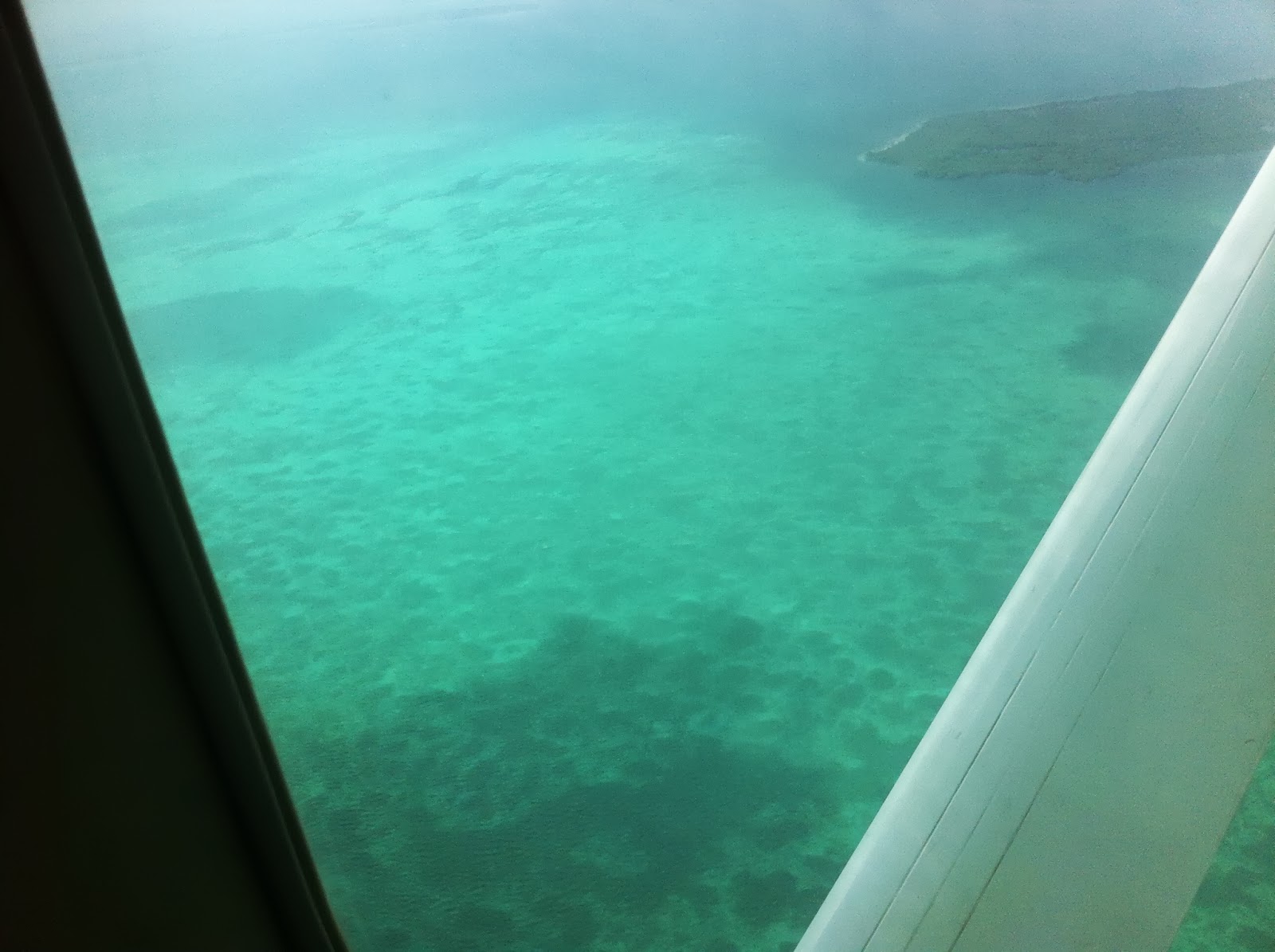
We were in Belize City for about 30 minutes before boarding a small plane and heading to the resort island of Ambergris Caye ( pronounced "am-BURR-gris key", essentially Caye meaning island).  Ambergris is the most commercialized island and is used by many organized tour groups as a base for water activities - snorkeling, diving, and fishing.  The plane ride offered stunning views of the azure water and habitats.  We didn't see the barrier reef ( the 4th largest barrier reef system in the world) as it is just to the east, but we did enjoy the sea grass beds and tiny cayes.  


Ambergris Caye with white caps on the
barrier reef visible along the top of photo.

Sea grass beds.


We ended our travel day at our inn in San Pedro, the Blue Tang Inn, with just enough time to go to the local bar and try one of my favorite travel experiments: what will they hand me when I just ask for, "a beer".  As expected, it was a Belikin, the Beer of Belize.  That and the sunset was a good end to the first day.

Last stop of the day.
Belikin Beer, local beer and main and often only choice.


Monday, July 1, 2013

It's Where Tabasco Comes From


Avery Island, Louisiana, one of the main stops on any tour of "Cajun Country".  Close to places like Abbeville, Delcambre, and Intracoastal City.  Oysters, crawfish, ducks, speckled trout, and of course, live oaks.

One of many glorious Live Oaks.
I think it says a lot of an area that when I try to write about it I am flooded more with memories and  emotions than words.

I come here as a supporter of the Rainey Conservation Alliance.

A partnership of conservation minded landowners interested in conserving the marsh.


What I have learned, more so than any conservation or biology lesson, is the importance of relationships.

Arriving at a private camp south of Avery Island.
So honored to get to represent Audubon as we renewed an agreement at this meeting.  Pictured From Left: Sherrill Sagrera, Harold "Took" Osborn, P.R. Burke, and myself.
the pros (so sorry I did not get their name)

The people of this area survive some of the harshest events mother nature can cook up.  Many of the communities, economies, and even ways of life have come and gone.

I find that if you take the time to listen though, you can not help but gain an appreciation for the interconnections, mutual dependencies, and rich shared history.

I was wrong at the beginning of this post.  Words....names....do come to mind when I think about this area.  The Osborns, McIlhennys, Simmons, Sagreras, Burkes, and Vincents; heroic families, and for me, privileged memories.

Sunday, October 4, 2009

Not Enough Time for Buenos Aires


On my way to Paraguay to lead a conservation planning workshop.

I have one night in Buenos Aires before flying to Asuncion in the morning.

That is not enough time for this town.


Everything I know about this city is what I could absorb in a mad dash.  I really, really, want to come back.

This is a romantic place.  Not syrupy, think Tango.  It is the work trip where you keep saying, "I wish my spouse was here.  They would love this."

Shopping Mall food ala Argentina ( Postavecchia).
I am sure you can find a bad meal.  I did not.

Case in point, I had to purchase some odds and ends and ended up at the galerias pacifico by my hotel.  Time for a steak and a glass of wine...in the food court!

Despite being lost and rushed, I did have good intelligence on lodging.  My friends and colleagues at Asociación Guyra Paraguay had made a reservation for me at the Hotel Diplomat.  This is a great little hotel near the Plaza San Martín in the Retiro neighborhood. I felt like the personal guest of the owners, Jorge Veiga and Jose Luis Perez.  Both are active supporters of Aves Argentinas and interested in natural history.  They gave me an open invitation to one of their research, nature photography, vacations in Mendoza Province.  They have a favorite place to camp in the foothills and high plains east of the Andes. (Added to Bucket List.)

If you are interested in birding Argentina, chances are you may fly into Buenos Aires.  Please give them your patronage.  I put a link in the caption below.  

Information and Reservations
Gracious, wonderful, hosts.


#buenos_aires ,  #birding_argentina , #galerias_pacifico ,